© Beyn Theater Group 2010 - 2026
All Rights Reserved
© Beyn Theater Group 2010 - 2026
All Rights Reserved

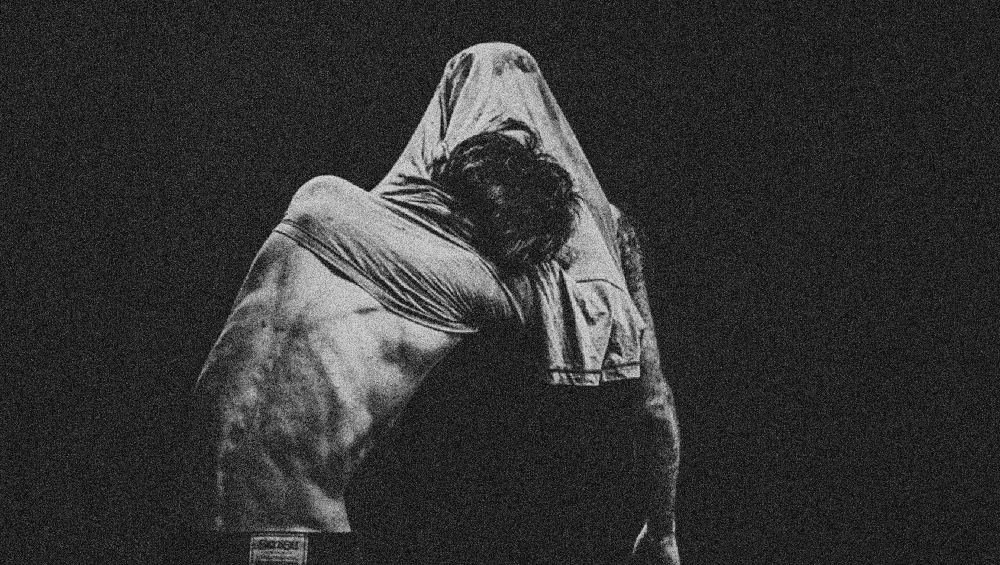
The When We Dead Awaken Project
Some projects are born from crisis, and find in that crisis the very material of their making. When We Dead Awaken is one of them — the second major work in Beyn Theater Group's continuing artistic journey, and the project through which a fractured group rediscovered its reason for working together.
A Group Divided (2013–2014)
In the aftermath of the first Macbeth production, Beyn Theater Group found itself fractured. The disagreement was not superficial; it touched something fundamental about how the group understood its own way of working — questions of process, of authority, of what theatre-making should even mean for a collective of this kind. These disagreements deepened over time, eventually splitting the group into two distinct factions, each pursuing its own answer to a question neither side could fully resolve together.
One faction carried forward the Part-Up project, continuing the line of exploration that had grown out of the open rehearsals in Laleh Park. The other turned inward, choosing not to chase a new production but to address what felt like a more urgent problem: the group's own continuity. This second faction began a series of workshops aimed at transmitting its accumulated vocal and physical techniques to a younger generation of performers — an attempt, in the midst of division, to reinvigorate the group from within, and perhaps to discover whether the work itself could survive the conflict that had splintered its makers. These workshops began in early 2014, conducted with no clear production in mind, driven instead by the conviction that the group's knowledge needed somewhere to go, regardless of what was happening between its senior members.
It was in the midst of this uncertain, searching period that Dr. Farindokht Zahedi suggested a text to the group: Ibsen's When We Dead Awaken. The timing gave the suggestion an unusual charge. The play's very title carried within it a promise — the idea of rising again — that felt almost uncannily suited to a group searching, consciously or not, for a way back to itself after rupture.
Early Rehearsals (2014)
Rehearsals began in a space on Keshvarz Boulevard, and from the outset, the work was organized around three central and interrelated threads. The first was Butoh dance, whose slow, interior physicality offered the group an entirely different vocabulary of the body than anything it had explored before — a vocabulary that seemed to resonate with the play's own preoccupation with what lies dormant beneath the surface of a life. The second was the deliberate cultivation of a network of communication between performers, developed in direct response to the group's growing engagement with the concept of otherness — an attempt to rebuild, through disciplined practice, the very capacity for connection that the recent conflict had strained. The third was the continued pursuit of musicality, now turned toward a more specific and unfamiliar target: not song or ceremony, but the rhythm, tone, and inner movement of dialogue itself.
Over the course of these rehearsals, the group developed genuine skill in Butoh, and began to uncover the musical qualities embedded in speech — discovering how shifts in cadence, repetition, and silence could transform the atmosphere of a scene and surface the ideas living beneath its words. From this foundation, the group began generating improvisations shaped simultaneously by this emerging dialogic musicality, by the physical language of Butoh, by the communicative network built between performers, and by the group's still-developing attentiveness to its surrounding environment. Each of these threads fed the others, so that by the end of this early phase, the rehearsal process had become less a rehearsal of a play and more a slow reassembly of the group's own working method — tested, this time, on unfamiliar ground.
Reunion and the House on Iranshahr Street (Early–Mid 2015)
In early 2015, the relationship between the two factions began to heal, and the group's older members returned. The rehearsals relocated to an abandoned house on Iranshahr Street — a space whose maze-like structure, rooms of varying sizes opening into one another, and a basement beneath it all, offered the group an unusually rich architecture to think with. The peculiar geography of the house became an invitation: to focus more deeply on environment, and to improvise according to the possibilities a given space provided.
Rehearsals continued through August 2015, by which point the group had entered the structuring phase of its process. Rather than moving directly toward a finished form, the group chose to stage a series of side performances — first in the house on Iranshahr Street, and later in the upstairs space of Hanooz Publication. These side performances opened the work to outside collaborators: singers, performers, writers, sculptors, painters, and other artists were invited to encounter the group's improvisations — themselves shaped by the group's evolving understanding of the Ibsen text and of the particular architecture each space offered — and to respond with work of their own devising. The dynamic of these gatherings, spanning voice, movement, and a range of other artistic forms, was guided primarily by Shahab Agahi as artistic director and Navid Gohari as music designer. Out of these encounters came new ideas that would shape both the opening and the closing of the eventual production.
Public Performances and Recognition (2015–2016)
Following the side performances, the production entered its final structuring process. When We Dead Awaken opened at Hafez Hall in September 2015, running through October. The opening night took the form of a musical gathering built around the songs woven through the performance — an interactive event that invited the audience directly into the production's sonic world before the play itself had even properly begun.
In February 2016, the production entered the International Fajr Festival, where it received nominations for Best Actor and Best Makeup Design, and won the Special Jury Prize in the international section.
Significance
Beyond its recognition, When We Dead Awaken carries a particular weight in the group's history: it was the project that brought its fractured members back together, allowing them to confront their differences honestly and still find a way to work side by side again.
It was also the first project in which the group's full framework of theatre-making — Preparations, Improvisations, Structuring, and Finalizing — was tested in its complete form and proved itself as a viable method. Preparation took shape through Butoh training, the evolving exploration of musicality in dialogue, and improvisations developed in dialogue with the surrounding environment. Improvisation deepened through material generated in response to other performers and to space. Structuring unfolded across the period before and after the side performances. And finalizing occurred through the side performances themselves and the public run that followed.
This was, too, the first time the group discovered real meaning and material in its relationship to the surrounding environment — an encounter that opened the group's eyes to the importance of the city's architecture as a creative collaborator, not merely a backdrop. And because of the particular nature of Ibsen's drama, the chorus and collective singing that had defined the group's earlier work receded, making room for the musicality of dialogue to be explored to its fullest extent — a discovery that would leave the group newly skillful in finding and improvising around this more intimate, spoken form of musical expression.
